
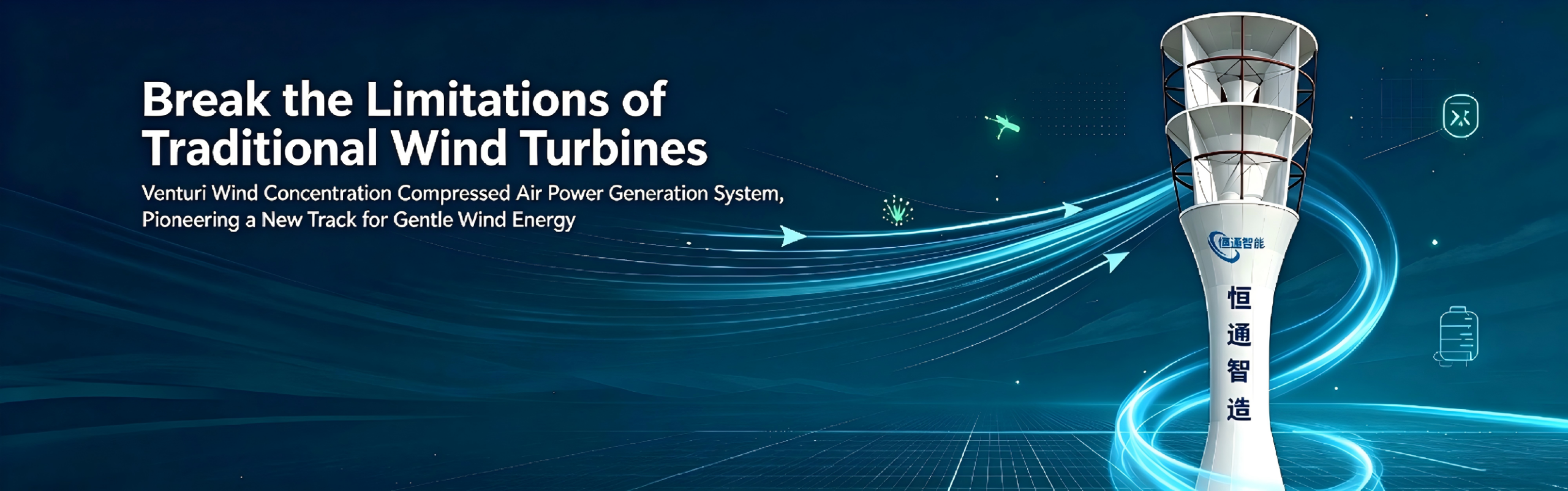
Breaking through the limitations of traditional wind turbines and pioneering a new frontier in micro-wind energy
For a long time, wind energy development has relied heavily on large horizontal-axis wind turbines, commonly known as ‘windmills’. Whilst the technology behind these turbines is well-established, their inherent limitations have restricted the deployment of wind energy in a wider range of scenarios. Traditional wind turbines require a relatively high cut-in wind speed to start operating, meaning that wind energy resources in areas with low wind speeds are regarded as ‘useless wind’; Furthermore, as wind energy is an intermittent source—with wind speeds fluctuating wildly—the electricity it directly generates is subject to severe fluctuations. Without energy storage systems, this can easily lead to issues such as shutdowns during calm periods and unstable power generation. The massive blades of large wind turbines occupy extensive areas and generate significant noise; consequently, siting must prioritise open locations such as high mountains, coastal areas and open countryside, making it difficult to integrate them into distributed electricity consumption scenarios such as industrial parks, towns, and industrial and mining sites.
Hengtong Intelligent Manufacturing’s (Hengtong Intelligent) Venturi-based air compression power generation system breaks away from the traditional ‘rotating blades to capture wind’ approach. By utilising the Venturi effect to concentrate and accelerate airflow, combined with an integrated air compression and energy storage design, it fundamentally resolves the challenge of utilising low wind speeds, thereby opening up a entirely new avenue for distributed wind power.
The entire system operates according to the process of ‘wind concentration and energy capture → high-efficiency power generation → compressed energy storage → stable power supply’. When a gentle natural breeze enters the multi-stage Venturi wind-concentrating structure of the wind tower, changes in the cross-sectional area of the passageway, in accordance with the Venturi effect, accelerate and amplify the incoming airflow. A gentle breeze of 2.8 m/s, having been accelerated by the air-concentrating structure, is then capable of driving the built-in axial flux motor into operation; this is the key factor behind the system’s ultra-low start-up wind speed of 2.8 m/s. Conventional wind turbines generally require a start-up wind speed of 3.0 m/s or higher; as a result, traditional equipment is unable to utilise the low average annual wind speeds found in many inland and suburban areas. This system, however, is capable of capturing and converting these otherwise wasted light wind resources.
Unlike conventional wind turbines, which ‘generate power when the wind blows and stop when it doesn’t’, Hengtong’s system incorporates an air compression energy storage unit. When wind speeds are high, in addition to generating electricity directly to supply the load, surplus energy is used to compress air, thereby storing the energy in the form of compressed air; when wind speeds decrease or there is a temporary lull, the stored compressed air can be released to continue driving the generator set and maintain a continuous output of electrical energy. This is equivalent to equipping wind power with an ‘energy buffer’, which smooths out the power fluctuations caused by wind speed variations, enabling a stable, round-the-clock power supply that is no longer solely ‘at the mercy of the wind’. The system operates stably within a wind speed range of 2.8 m/s to 25 m/s. It is equipped with reliable protection mechanisms for high-wind conditions; unlike conventional wind turbines, which must shut down immediately to protect the blades when wind speeds are too high, this system broadens the operational wind speed window.
The system also supports wind-solar hybrid configurations and can be seamlessly integrated with photovoltaic solar power. During the day, when sunlight is abundant, the solar system generates power; when the wind blows, the wind turbine system generates power. The wind and solar systems complement each other, further reducing fluctuations in power supply. This combined solution is ideally suited to scenarios such as zero-carbon industrial parks, remote villages and towns, islands, on-site power generation for industrial and mining operations, and power supply for mobile phone base stations. The tower’s vertical structure is compact; without long, rotating blades, it occupies far less land area than traditional wind turbines of equivalent capacity. It operates more quietly, is more bird-friendly and offers significantly greater flexibility in site selection, eliminating the need to be confined to wind farms in remote rural areas.
The intelligent control system acts as the ‘brain’ of the entire installation. It collects various parameters in real time—such as wind speed, atmospheric pressure, energy storage pressure, and output voltage and current—and automatically regulates the entire process of air collection, compression, energy release and power generation, dynamically adapting to the electrical load. The system monitors the operational status of the equipment in real time and features built-in fault warning and remote monitoring functions, facilitating operation and maintenance whilst reducing the costs associated with on-site manual inspections.
Against the backdrop of the ‘dual carbon’ targets, demand for distributed clean energy continues to rise. In many areas, it is not that there is no wind, but rather that wind speeds are too low for traditional large wind turbines to operate at full capacity. The Hengtong Intelligent Venturi Wind Concentration Air Compression Power Generation System transforms previously difficult-to-utilise light wind resources into reliably dispatchable electricity. It is not merely a simple modification of traditional wind turbines, but a distributed wind energy solution based on an entirely new approach. It offers new options for zero-carbon development, corporate self-generated green electricity and off-grid power supply in low-wind-speed areas, enabling even light winds to generate sustainable and stable clean energy value.