
New Measures for Energy Conservation and Carbon Reduction
Against the backdrop of the ongoing implementation of the ‘Dual Carbon’ policy and increasingly stringent controls on industrial energy consumption, many manufacturing enterprises are facing a range of challenges, including high electricity costs, tight energy consumption targets, significant pressure to reduce carbon emissions, and difficulties in obtaining green factory certification.
Traditional energy-saving retrofits are limited in scope, offering only modest cost reductions through equipment optimisation and electricity conservation, whilst failing to address at the root the issues of high energy consumption and heavy reliance on the grid. Developing in-house distributed green electricity has become the key pathway for industrial and commercial sites to reduce costs and carbon emissions, whilst enhancing their core competitiveness.
Most industrial estates are situated in inland areas with low wind speeds, where the conditions are not suitable for large-scale wind power projects; consequently, many enterprises have no choice but to opt for a single-source photovoltaic retrofit. However, photovoltaic systems only generate electricity during the day and produce nothing at night; their efficiency is extremely low on overcast or rainy days, making them unable to meet the estate’s round-the-clock electricity requirements.
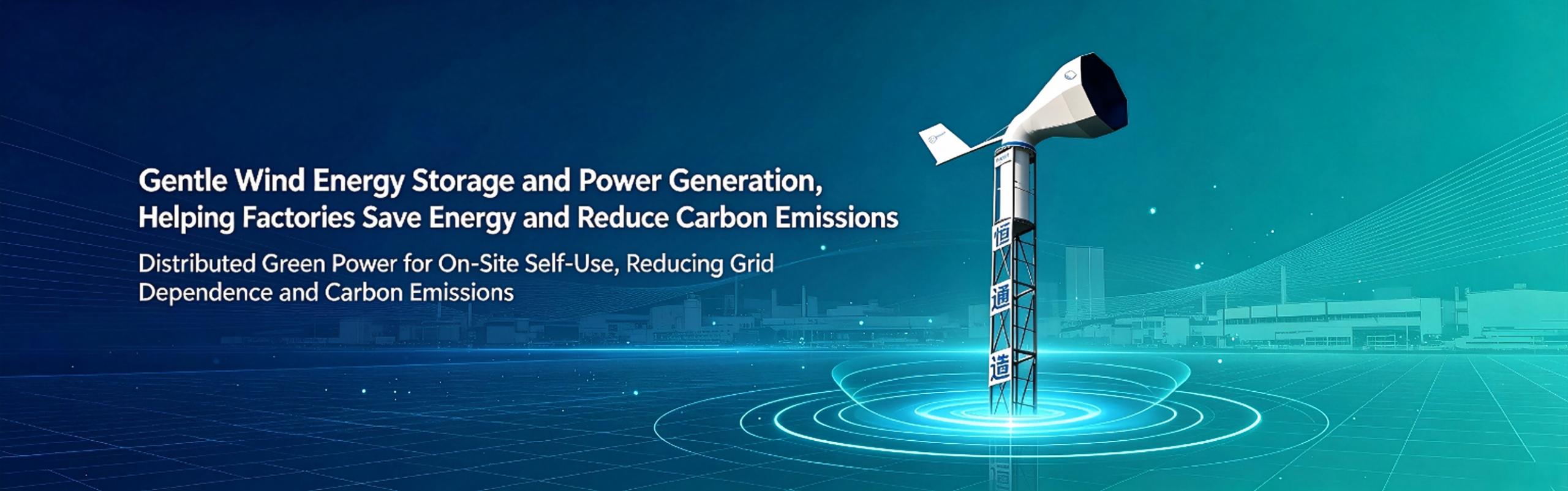
Hengtong Intelligent Manufacturing’s low-wind-speed energy storage power generation system offers a comprehensive solution for energy conservation and carbon reduction on industrial sites, delivering a multi-dimensional supply of green electricity through a combination of ‘wind power + energy storage + optional solar power’, thereby addressing the shortcomings of solar-only retrofits.
The equipment is specifically designed for complex factory environments; its compact tower-style structure does not occupy production space. With no large blades, it operates safely and quietly, causing no disruption to factory production or office work. Thanks to its ultra-low start-up wind speed of 2.8 m/s, it can harness the gentle breezes and gusts typical of factory environments, enabling continuous power generation around the clock and effectively bridging the gap in power generation left by photovoltaic systems at night or on overcast and rainy days. When paired with an air compression energy storage system, it ensures a stable power output, mitigating issues such as peak-to-valley fluctuations and voltage instability in the grid, and is suitable for powering factory lighting, office equipment, surveillance systems, auxiliary equipment and small-scale production machinery.
By deploying micro-wind energy storage systems, enterprises can generate electricity locally for on-site consumption, thereby significantly reducing the volume of electricity purchased from the grid during peak periods and effectively cutting electricity costs; at the same time, as clean wind power produces zero emissions and causes no pollution, it can be directly offset against the enterprise’s carbon emissions, helping the enterprise to successfully meet energy-saving targets and carbon emission quotas, and accelerate the certification process for green factories and zero-carbon industrial parks.
Compared with traditional photovoltaic systems, diesel-powered generators and large-scale wind farms, this system requires a lower initial investment, occupies less space, is simpler to operate and maintain, and is more adaptable to different environments. It is not subject to severe weather or site constraints, making it a lightweight, cost-effective and long-term, stable solution for energy saving and carbon reduction in industrial and commercial premises at this stage.