
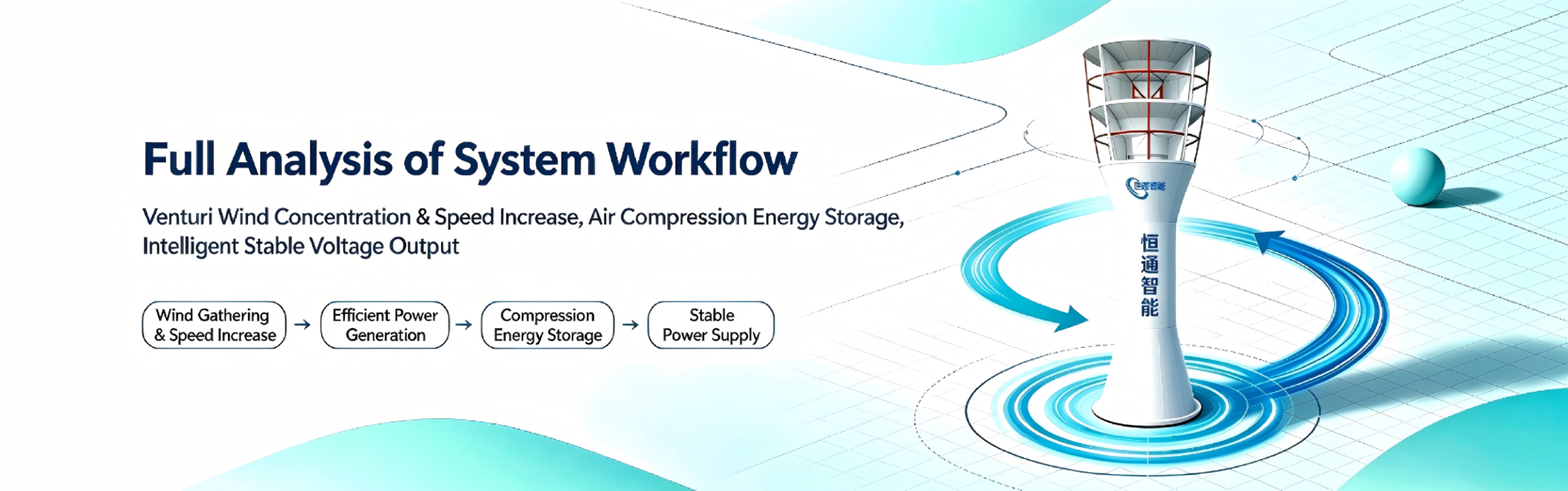
Workflow of an Air Compression Power Generation System
In today’s rapidly evolving new energy sector, wind power is by no means an unfamiliar concept; however, the vast majority of people’s understanding of wind power remains confined to the traditional image of large, three-bladed wind turbines. Traditional wind power relies on large blades to capture kinetic energy directly from natural winds, with its power generation efficiency entirely dependent on wind speed—a system that has clear limitations and is ill-suited to small- and medium-scale distributed power consumption scenarios. In contrast, the micro-wind energy storage and power generation system independently developed by Hengtong Intelligent Manufacturing has completely broken away from the single-mode operation of traditional wind power. Drawing on four core technologies—the Venturi wind concentration principle, high-efficiency axial flux power generation, air compression energy storage, and intelligent voltage stabilisation and regulation—it has established a comprehensive, closed-loop and sustainable micro-wind power generation and energy storage system. Every stage of the system—from low-wind capture and energy conversion to energy storage and stable power generation—has undergone meticulous technical optimisation. This perfectly addresses the industry pain points associated with traditional wind power—namely, its intermittent nature, instability and high start-up thresholds—making it the core solution for distributed green electricity in low-wind-speed areas.
Unlike the crude power-generation logic of traditional wind turbines—which ‘spin when the wind blows, stop when it does not, suffer from unstable wind speeds and cause fluctuations in electricity supply’—Hengtong Intelligent Manufacturing’s air-compression power generation system features a standardised, intelligent, closed-loop four-step operational process. Through a series of progressive stages, it maximises the utilisation of even the faintest wind energy, truly achieving ‘capturing the slightest breeze, utilising weak winds, storing surplus energy, maintaining power supply during calm conditions, and delivering constant-voltage output’. Below, we provide a detailed breakdown of the complete operational logic of the entire system.
Venturi-effect air convergence capture: breaking down barriers to the utilisation of gentle breezes
Gentle breezes in the natural environment are a clean energy source found throughout urban and rural areas, industrial estates and the countryside; however, these weak air currents—with typical wind speeds of 2–3 m/s—possess extremely low kinetic energy and are unable to drive conventional wind turbines, leaving them in a state of ‘idle waste’ for long periods. This is also the core reason why wind power projects struggle to be implemented in most low-wind-speed regions across the country. Hengtong Intelligent Manufacturing has innovatively applied the Venturi fluid dynamics effect and customised a dedicated tower-type wind-concentrating cavity structure to resolve the challenge of capturing light winds at its very root.
The entire air-concentrating structure employs a streamlined cavity design that is wide at the inlet and narrow at the outlet. Natural breezes flow in from all directions through the unit’s wide air intake ports; as the cross-section of the cavity gradually narrows—strictly adhering to the physical principles of the Venturi effect—the airflow velocity rapidly multiplies and the air pressure is precisely adjusted. This transforms the natural breeze, which originally had dispersed kinetic energy and weak force, into a concentrated, high-speed, stable and effective airflow capable of performing work. Following structural optimisation to increase airflow velocity, even an ultra-low ambient breeze of 2.8 m/s is sufficient to generate adequate driving force to trigger the unit’s start-up, significantly lowering the start-up threshold by more than 30 per cent compared to traditional fans.
At the same time, the unit features an open, all-directional air intake design, eliminating the need for precise alignment with the wind and enabling it to adapt to random fluctuations in natural wind direction. This overcomes the shortcomings of traditional wind turbines—which require reorientation and are limited by their wind-facing surface area—and accommodates an exceptionally wide wind speed range of 2.8 m/s to 25 m/s. Whether it is a gentle breeze at dawn, variable gusts during the day, or persistent light winds during the rainy season, the unit captures wind energy efficiently, significantly enhancing the utilisation of wind energy throughout the year.
High-efficiency energy conversion, precisely powered by axial flux motors
Once the gentle breeze has been concentrated and accelerated to generate effective kinetic energy, the system enters the core energy conversion stage, which is also the key to ensuring power generation efficiency. Hengtong Intelligent Manufacturing has moved away from the radial flux motors commonly used in traditional wind power systems and instead employs a high-efficiency axial flux motor developed in-house. This motor is specifically designed for low-wind-speed, low-rotational-speed and wide-operating-condition scenarios, and is perfectly suited to the power-generating characteristics of the airflow following Venturi concentration.
Conventional motors suffer from issues such as insufficient torque, low conversion efficiency and high idle power consumption under low-speed operating conditions; even when the blades are rotating, they struggle to generate effective electrical energy, resulting in a waste of wind energy resources. Axial flux motors, on the other hand, offer higher power density, a wider range of efficient operation and stronger low-speed torque; they are capable of maintaining high-efficiency energy conversion even when driven by low-speed airflow, with no ineffective idling and no waste of energy.
The impeller of the high-speed air-concentrating airflow drive unit rotates smoothly, converting fluid kinetic energy into mechanical potential energy, which is then precisely converted from mechanical to electrical energy by an axial flux motor. Energy loss throughout the process is extremely low, and conversion efficiency remains stable. This technological upgrade fully harnesses the energy potential of even the weakest wind, enabling highly efficient power generation in low-wind-speed environments and thereby strengthening the equipment’s core power-generation capability at the hardware level.
Air compression energy storage: achieving a closed-loop energy storage system
Unstable power generation and intermittent power supply are the fatal weaknesses of all conventional wind power systems, and also the core bottlenecks hindering the widespread adoption of distributed wind power. Conventional wind turbines lack energy storage mechanisms; their power output fluctuates entirely in line with wind speed, leading to overloading in strong winds and power cuts in light winds. Consequently, they cannot be directly connected to precision electrical equipment, nor can they serve as a continuous power source. Hengtong Intelligent Manufacturing’s air compression power generation system is equipped with a proprietary air compression energy storage unit and pioneers an operational model of ‘generate first, store later, release energy on demand’, thereby completely transforming the ‘weather-dependent’ nature of wind power.
When there is an abundant supply of natural wind and the power generated exceeds current electricity demand, the system does not allow the surplus energy to go to waste; instead, it automatically activates energy storage mode. The surplus energy drives an air compressor unit, which filters, compresses and stabilises atmospheric air, converting it into high-pressure air that is stored under seal in a dedicated energy storage chamber. This allows the excess wind energy to be fully retained in the form of pneumatic potential energy, thereby enabling the effective storage of clean energy.
The entire energy storage unit features a silent, sealed design, offering high pressure resistance, a high level of safety and zero leakage losses. It enables long-term, stable energy storage without the need for frequent maintenance, thereby addressing the key challenges of energy wastage and the inability to store energy associated with traditional wind power, and laying a solid energy foundation for continuous power supply during subsequent periods of no wind or light winds.
Intelligent voltage stabilisation and power release, ensuring a stable power supply around the clock
Energy storage is merely the foundation; stable power output is the core requirement for distributed electricity consumption scenarios. The Hengtong Smart Manufacturing System is equipped with an intelligent CNC voltage stabilisation system, which continuously monitors dozens of operational parameters in real time—including ambient wind speed, energy storage pressure, power generation output, output voltage and electricity load—and uses AI algorithms to dynamically adjust the energy release rate and power generation conditions, thereby ensuring precise and controllable power output.
When ambient wind speeds decrease, there is insufficient breeze, or when there is no wind at night and electricity demand rises, the system automatically switches to energy-release power generation mode, systematically releasing the high-pressure compressed air stored within the chamber to drive the generator set in reverse, thereby generating electricity continuously. The system does not rely on natural wind at any stage, but instead relies entirely on stored clean energy to maintain a continuous power supply, perfectly bridging the gap in power supply during periods of low wind.
At the same time, the intelligent voltage stabilisation system calibrates the output voltage and current in real time, smoothing out fluctuations in power caused by variations in wind speed and load changes. This eliminates issues such as sudden voltage spikes and drops, power interruptions and unstable waveforms, ensuring a clean, stable and compliant power output. It is directly compatible with a wide range of power consumption scenarios, including industrial equipment, domestic lighting, telecommunications base stations and smart devices, without the need for additional voltage stabilisation equipment.
Integrating wind and solar power to create an all-weather energy system
To further enhance the equipment’s ability to provide round-the-clock power supply and its energy self-sufficiency rate, Hengtong Intelligent Manufacturing’s air compressor power generation system supports modular expansion through wind-solar hybrid configurations. It allows for the flexible integration of photovoltaic modules according to the user’s site conditions and electricity requirements, enabling the creation of an integrated wind-solar distributed energy system.
During the day when there is ample sunlight, the photovoltaic system takes priority in generating electricity to supplement the grid, alleviating the load on the wind power system, whilst also providing auxiliary charging for the energy storage units; during overcast, rainy or night-time periods, or when there is no sunlight, the micro-wind power system and energy storage units take over to supply power. The two clean energy systems complement each other’s strengths and provide mutual backup, completely overcoming the limitations of relying on a single energy source. Whether the weather is sunny, overcast, rainy or windless, the system ensures a continuous and stable power supply, significantly increasing the annual operating time and energy utilisation of the entire system. It is ideally suited to high-end applications such as zero-carbon industrial estates, integrated photovoltaic and wind power upgrades in rural areas, and long-term power supply for remote base stations.