
Advantages of Blade-less Wind Turbines Compared to Traditional Wind Turbines: A New Era of Innovation in Wind Power
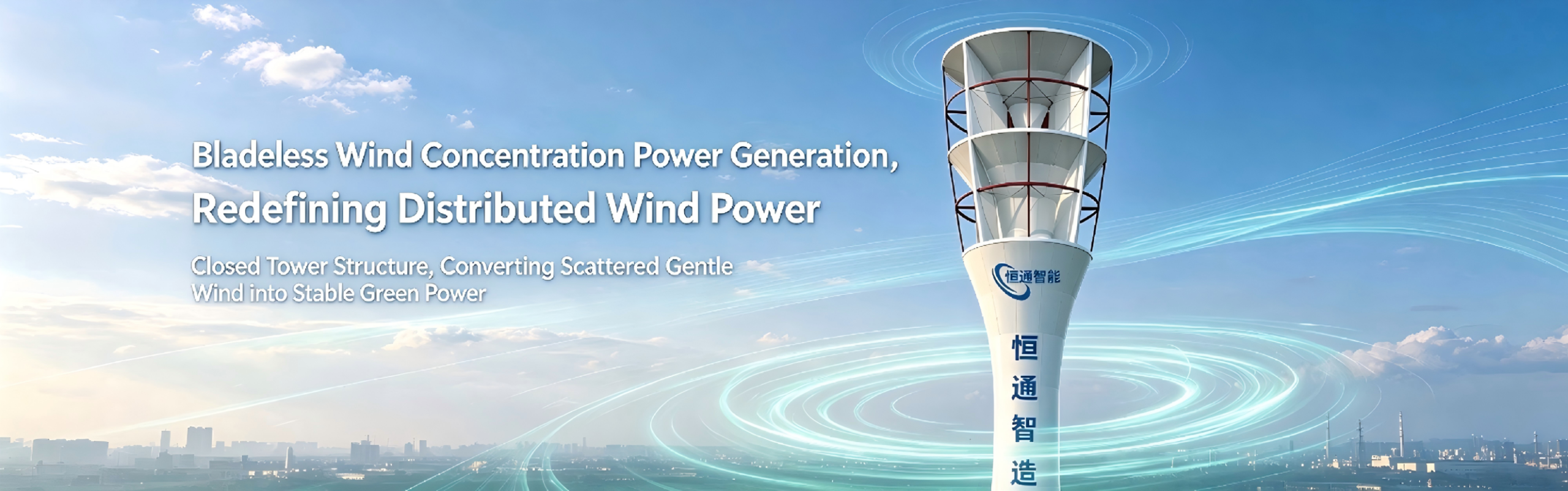
For a long time, the public’s perception of wind power has remained confined to the traditional image of ‘giant three-bladed wind turbines’. Whilst traditional horizontal-axis wind turbine technology is well-established, it suffers from inherent limitations that prevent it from being suitable for distributed, lightweight, and close-proximity power generation scenarios on the consumer side. With the iterative advancement of renewable energy technologies, bladeless air-concentrating power generation technologies—represented by Hengtong Intelligent Manufacturing’s Venturi-type low-wind-speed power generation system—have completely redefined the operational logic of wind power. Thanks to their multiple core advantages, these technologies are gradually emerging as a new trend in the distributed clean energy market.
In terms of structural safety, traditional wind turbines rely on high-speed rotation of extremely long blades to capture wind; these blades can reach lengths of several tens of metres. During operation, they present issues such as a wide wind-swept area, numerous safety hazards, noise nuisance and accidental bird strikes, and their deployment is generally prohibited in areas surrounding cities, industrial estates and densely populated areas. In contrast, Hengtong Intelligent Manufacturing’s wind-concentrating power generation system abandons the traditional blade structure in favour of a closed-tower wind-concentrating design with no exposed rotating parts. It operates safely and stably without the risks associated with high-altitude rotation, and does not require extensive safety exclusion zones. Consequently, it can be deployed in close proximity to people, factory buildings and other structures, making it suitable for the vast majority of scenarios where traditional wind turbines cannot be installed.
In terms of environmental adaptability, traditional wind turbines can only operate efficiently in conditions of strong, steady winds; their power generation efficiency drops sharply under conditions of light winds, gusts or turbulent winds, demonstrating extremely poor environmental adaptability. The bladeless wind-concentrating power generation system, based on the Venturi fluid concentration principle, can collect scattered air currents, turbulent winds and light breezes from all directions. It is not restricted by wind direction nor reliant on strong winds; it can be activated at just 2.8 m/s and operates stably across an exceptionally wide wind speed range of 2.8–25 m/s. Whether in everyday light winds or variable gusts, it can efficiently capture and convert wind energy, achieving a wind energy utilisation rate far exceeding that of traditional equipment.
In terms of power supply stability, traditional wind power is typically ‘weather-dependent’; fluctuations in wind speed directly lead to fluctuations in electricity output. When there is no wind, the turbines shut down, meaning they cannot be used as a stable power source on their own and must rely on the grid as a safety net or the installation of additional energy storage equipment. Hengtong Intelligent Manufacturing’s equipment is equipped with an integrated air compression energy storage unit, enabling the integrated operation of power generation, energy storage, voltage stabilisation and energy release. It can autonomously smooth out fluctuations in wind power, providing continuous power supply around the clock with a clean and stable output. As no additional voltage stabilisation or energy storage equipment is required, the overall operating costs are lower.
In terms of operational and maintenance costs, traditional wind turbines have complex structures, blades that are prone to wear and tear, and frequent faults at height, requiring specialist teams to carry out regular high-altitude inspections and maintenance, resulting in high operational and maintenance costs. Blade-less air concentrators, on the other hand, feature a simple structure, have no vulnerable rotating parts, offer excellent overall sealing, and have an extremely low failure rate. Their day-to-day operation and maintenance are straightforward, with basic inspections able to be carried out by ordinary staff, offering significant value for money over the long term.
In terms of industry trends, traditional large-scale wind turbines are primarily geared towards centralised, large-scale grid-connected power generation, whilst bladeless wind-concentrating micro-wind power generation focuses on distributed, consumer-side and lightweight green electricity applications. The two technologies complement each other perfectly and represent a key innovative direction for the diversified development of wind power in the new era.