
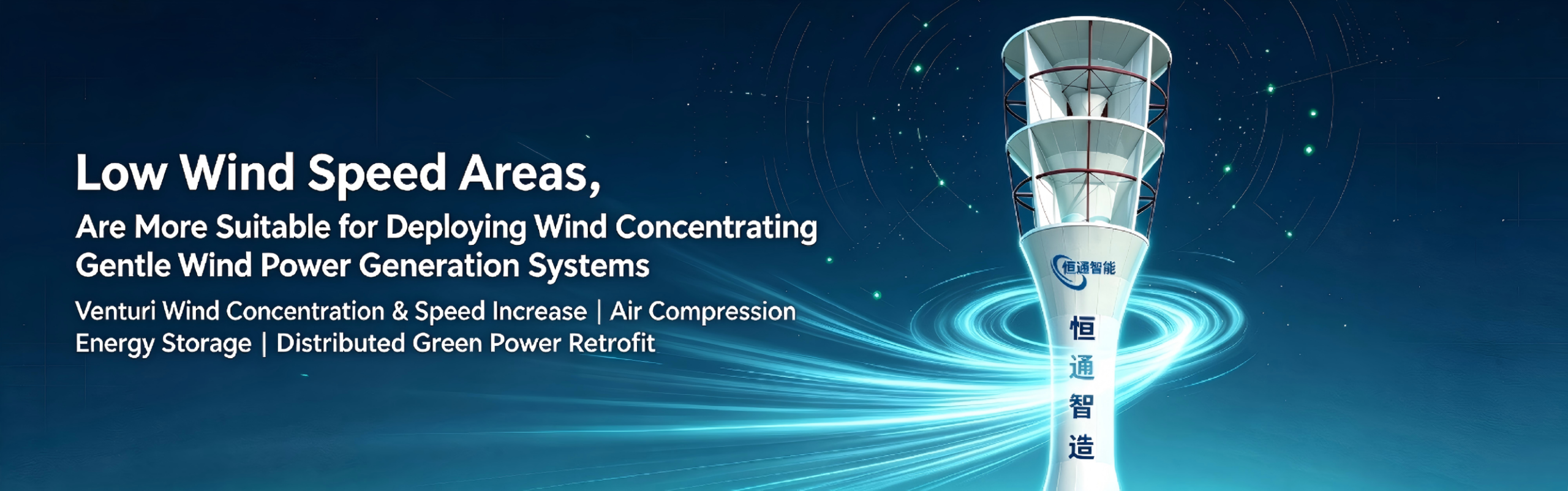
Why are areas with low wind speeds more suitable for the deployment of wind-concentrating micro-wind power systems?
The distribution of wind energy resources in China exhibits marked regional variations. The northern grasslands and coastal wind corridors are high-wind-speed areas and have traditionally been the main locations for large-scale wind power projects. In contrast, the Central, Eastern, Southern and South-Western regions—which account for the majority of the country’s territory—are all typical low-wind-speed areas, characterised by low average annual wind speeds, scattered wind patterns and variable gusts, making the development of wind energy resources there a long-standing challenge. Traditional large-scale wind turbines have extremely high requirements for natural wind speeds; not only do they have a high cut-in speed threshold, but their power generation efficiency is also extremely low in light wind conditions, resulting in a lengthy payback period. Consequently, the vast majority of industrial and commercial sites, as well as rural locations, are entirely unsuitable for the installation of large-scale wind turbines.
The distribution of wind energy resources in China exhibits marked regional variations. The northern grasslands and coastal wind corridors are high-wind-speed areas and have traditionally been the main locations for large-scale wind power projects. In contrast, the Central, Eastern, Southern and South-Western regions—which account for the majority of the country’s territory—are all typical low-wind-speed areas, characterised by low average annual wind speeds, scattered wind patterns and variable gusts, making the development of wind energy resources there a long-standing challenge. Traditional large-scale wind turbines have extremely high requirements for natural wind speeds; not only do they have a high cut-in speed threshold, but their power generation efficiency is also extremely low in light wind conditions, resulting in a lengthy payback period. Consequently, the vast majority of industrial and commercial sites, as well as rural locations, are entirely unsuitable for the installation of large-scale wind turbines.
Traditional wind turbines rely on large-surface-area blades to passively capture wind; when wind speeds are insufficient, they can only spin idly or shut down, and are unable to generate effective electricity. In contrast, this system utilises a proprietary wind-concentrating chamber structure to actively gather scattered air currents from the surrounding area. By applying the principles of fluid dynamics, it multiplies the internal wind speed, converting an ultra-low breeze of 2.8 m/s into an effective, energy-generating airflow, thereby enabling operation with an extremely low start-up threshold. Compared with the start-up threshold of 3 m/s or above required by conventional wind turbines, this system significantly increases the annual power generation duration in areas with low wind speeds, transforming previously overlooked and ineffective micro-wind resources into a clean energy source that can be utilised on a regular basis.
Furthermore, areas with low wind speeds are typically densely populated, characterised by a concentration of industrial sites and limited land resources; traditional large wind turbines, which occupy a vast area, generate significant noise and require extensive safety buffer zones, are highly susceptible to site constraints. Hengtong Intelligent Manufacturing’s micro-wind power generation equipment utilises a compact tower-type structure; it has no large rotating blades, operates quietly and offers a high safety margin. It can be flexibly deployed in confined spaces such as open areas within industrial estates, along roadsides, in rural courtyards and on agricultural sites, without the need for large-scale land acquisition, thereby significantly lowering the barriers to wind power implementation.
Equipped with a built-in compressed air energy storage system, the equipment perfectly addresses the issues of unstable wind conditions and significant fluctuations in gusts in areas with low wind speeds. By storing energy when the wind blows and releasing it to generate electricity when it is calm, the system completely eliminates the intermittent power supply associated with traditional wind power, delivering stable and controllable output that is perfectly suited to the distributed electricity needs of low-wind-speed regions. For numerous inland cities, industrial estates and rural areas, this system fills a gap in the market for low-wind-speed wind power development, emerging as the new workhorse for distributed green energy retrofits.