
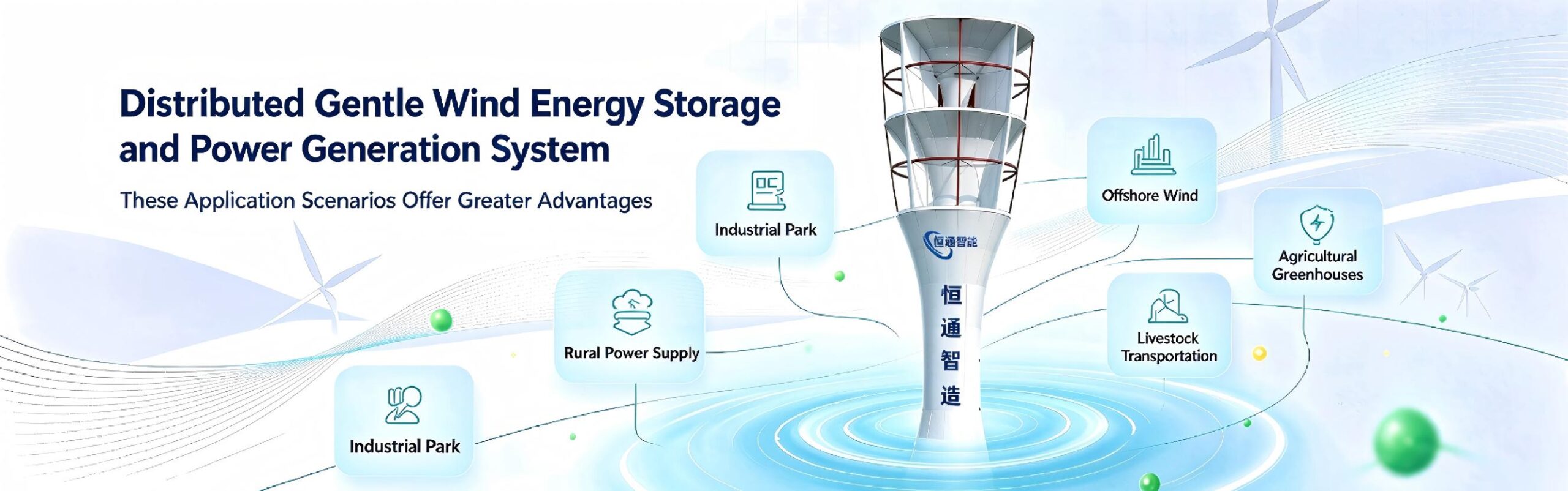
Application scenarios for the Breeze Energy Storage and Power Generation System
With the ‘Dual Carbon’ policy now fully implemented and enterprises’ demands for energy conservation and carbon reduction continuing to rise, the application of clean energy is no longer confined to large-scale energy projects such as major wind farms and centralised solar power stations. An increasing number of small and medium-sized enterprises, rural areas, remote operational sites and agricultural and livestock farming bases are now in urgent need of distributed green energy equipment that is compact, flexible to deploy, suitable for low wind speeds, provides a stable power supply and requires minimal maintenance. Traditional large-scale wind turbines impose extremely stringent requirements in terms of wind speed, site location, terrain and construction conditions; as such, they cannot be deployed close to the end-user and struggle to meet market demand for decentralised, small-scale and locally sourced electricity.
Hengtong Intelligent Manufacturing’s air-compression micro-wind energy storage and power generation system, utilising proprietary Venturi air-concentration and speed-increase technology, high-efficiency axial flux power generation technology and an air-compression energy storage voltage stabilisation system, has completely overcome the reliance of traditional wind power on high wind speeds, large sites and open environments. The system is suitable for the vast majority of low-wind-speed regions in China, enabling efficient capture of energy from light winds, storage of surplus energy and continuous power supply even in calm conditions. With its multiple core advantages – including a low start-up wind speed, no large blades, low-noise operation, integrated energy storage, intelligent voltage stabilisation and the ability to complement wind and solar power – it is perfectly suited to distributed power consumption scenarios across multiple industries, making it the preferred solution for current small- and medium-scale zero-carbon retrofits, self-generated green electricity and emergency backup power supply.
On-site generation and consumption within industrial estates helps businesses reduce costs and cut carbon emissions
The vast majority of industrial estates and manufacturing sites in China are located in inland areas with low wind speeds, characterised by generally weak winds and erratic wind directions, which are entirely unsuitable for the installation of traditional large-scale wind turbines. Furthermore, with their dense concentration of buildings, numerous pieces of equipment and limited available open space, these sites simply cannot accommodate traditional wind power installations, which require extensive land and wide safety buffer zones. Furthermore, industrial production involves stable electricity demand and high energy consumption, whilst grid electricity prices are rising year on year, placing increasing pressure on enterprises’ electricity costs. Many factories are in urgent need of a stable supply of self-generated green electricity to reduce their electricity expenditure and meet energy-saving targets and zero-carbon conversion requirements.
Hengtong Intelligent Manufacturing’s distributed micro-wind and energy storage power generation system is perfectly suited to factory environments. The system features a compact tower-style structure; it is small in size and requires very little space, eliminating the need for large open areas. It can be deployed in open spaces within the factory grounds, along roadsides, or on unused paved surfaces, without encroaching on production areas. As the system does not feature large, high-speed rotating blades, it offers a high level of operational safety and poses no safety risks to factory equipment, personnel or buildings. Furthermore, its extremely low operating noise levels ensure it does not disrupt workshop production or the office environment within the factory grounds.
Leveraging the advantage of an ultra-low start-up wind speed of 2.8 m/s, the system can capture even the faintest natural breezes on site around the clock, generating electricity continuously and reliably. Combined with a built-in air compression energy storage unit, it effectively smooths out fluctuations in power generation caused by gusts and light winds on site, preventing sudden spikes or drops in power output. The resulting stable and clean electricity can be used directly for site lighting, office power, small-scale production support equipment and surveillance systems. By generating and consuming green electricity on-site, enterprises can effectively reduce their reliance on the mains grid, significantly cut electricity costs and simultaneously reduce carbon emissions. This helps businesses meet energy-saving and carbon-reduction targets, achieve green factory certification and upgrade to zero-carbon industrial estates, thereby enhancing their green brand value.
Rural distributed green electricity retrofits to improve electricity supply security at the grassroots level
In many rural areas, village courtyards and agricultural parks, problems such as low wind speeds, long power lines and poor supply stability are widespread. In remote rural areas, ageing power grid lines and high transmission losses mean that voltage instability and power cuts are common during peak consumption periods; at the same time, the complex terrain and scattered open spaces in rural areas make the large-scale deployment of traditional large-scale wind and solar power equipment difficult, costly and with a long payback period, making it hard to fundamentally improve rural electricity supply conditions. With the advancement of policies promoting rural revitalisation and the expansion of green energy into rural areas, demand for electricity for domestic use, agricultural equipment and rural public facilities continues to rise. Stable, low-cost and easy-to-maintain distributed clean energy systems have thus become an essential requirement for the upgrading of rural energy infrastructure.
Hengtong Intelligent Manufacturing’s micro wind-storage power generation system is highly suited to rural settings. The equipment offers flexible installation, straightforward construction and convenient operation and maintenance; it does not require a specialist O&M team, as routine inspections and maintenance can be carried out by ordinary rural staff, thereby significantly reducing long-term O&M costs. The units can be deployed individually to supplement the basic power supply, networked together to form small-scale distributed wind farms, or combined with photovoltaic modules to create wind-solar hybrid systems, enabling the coordinated supply of power from both wind and solar energy sources.
In everyday scenarios, the system can provide a stable supply of green electricity for lighting in rural homes, public street lighting, CCTV and security systems, irrigation equipment and small agricultural machinery; in special circumstances such as grid maintenance or sudden power cuts, the energy storage units can continuously release energy to supply power, acting as an emergency backup power source and effectively addressing the challenges of unstable rural power supply and the lack of emergency power. The entire system is tailored to the decentralised and low-demand nature of rural electricity consumption, offering a cost-effective, practical solution for achieving zero-carbon development in rural areas, promoting the widespread adoption of green energy, and reducing the burden on the electricity grid.
Outdoor base stations and remote sites: solving the challenge of off-grid power supply
Remote locations such as telecommunications base stations, meteorological monitoring stations, forest fire monitoring stations, field exploration sites and outdoor work camps are mostly situated far from the main municipal electricity grid; connecting them to the grid is difficult, construction costs are high, and line losses are significant. Traditional power supply in the field relies primarily on diesel generators, which not only consume large amounts of fuel and incur high generation costs, but also produce significant operational noise, cause severe exhaust pollution, suffer from high equipment failure rates and require cumbersome daily maintenance; their long-term use is therefore extremely poor in terms of both economic efficiency and environmental sustainability. The core requirements for power supply in such scenarios are: continuous and stable power, minimal need for frequent operation and maintenance, strong environmental adaptability, and the ability to provide uninterrupted power supply around the clock.
Hengtong Intelligent Manufacturing’s distributed micro-wind energy storage power generation system is perfectly suited to off-grid outdoor environments. The equipment is highly adaptable to its surroundings, withstanding complex outdoor weather conditions such as extreme temperatures, gusts and overcast or rainy weather. It operates stably across an exceptionally wide wind speed range of 2.8 m/s to 25 m/s, with an annual operational duration far exceeding that of conventional wind power equipment. Utilising a closed-loop air compression energy storage system, the system is capable of ‘storing energy when the wind blows and supplying power when it does not’, thereby completely eliminating dependence on weather conditions and the mains grid, and delivering a stable, uninterrupted power supply around the clock.
The system also supports fully automated, intelligent operation, featuring remote monitoring, fault early warning and intelligent control functions. As it does not require on-site staff, it significantly reduces labour costs associated with the operation and maintenance of remote sites. When paired with a hybrid wind-solar module, it enables bidirectional backup power from both wind and solar energy, thereby completely resolving the industry-wide challenges of unstable, costly and polluting off-grid power supply in remote areas. It is the core power supply solution for unmanned remote sites and remote operational camps.
Crop and Livestock Farming Bases: Building a Green, Low-Carbon Electricity System for Agriculture
Agricultural settings such as modern agricultural greenhouses, large-scale livestock farming bases and fruit and vegetable seedling nurseries generally feature open spaces and good ventilation; however, wind speeds in these areas are unstable and vary significantly between day and night. Such settings require a continuous power supply throughout the year to operate equipment such as greenhouse ventilation and temperature control systems, sprinkler irrigation, supplemental lighting, aquaculture water recirculation systems, disinfection equipment, and surveillance and security systems. The long-term consumption of mains electricity is substantial, resulting in persistently high electricity costs for agricultural production. At the same time, traditional agriculture lacks the necessary clean energy infrastructure, making it difficult to achieve the transition to green and ecological agriculture.
Hengtong Intelligent Manufacturing’s Micro Wind Energy Storage and Power Generation System is ideally suited to agricultural settings. The equipment is compact and can be flexibly installed in gaps between greenhouses, on vacant land within livestock farms, or along the sides of roads within agricultural estates; it does not occupy land used for crop cultivation or livestock rearing, nor does it interfere with agricultural operations. The equipment operates without noise, exhaust fumes or pollutant emissions, and has no adverse impact on livestock rearing or crop growth, thus fully complying with the standards for ecological agriculture.
In response to the fluctuating wind speeds typical of agricultural environments, the system utilises wind-concentrating technology to maximise the capture of scattered breezes, whilst relying on energy storage units to smooth out fluctuations in wind power, thereby ensuring a continuous and stable power supply that is fully suited to the long-term operational requirements of agricultural equipment. By generating and consuming its own green electricity, the facility can effectively reduce the consumption of mains electricity in agricultural production, lower the operational costs of livestock farming and crop cultivation, and simultaneously establish a green, low-carbon agricultural demonstration base, thereby supporting the green transformation of the agricultural sector and enhancing its quality and efficiency.
Public cultural and tourism venues and outdoor settings: the preferred choice for lightweight, green power supply
Public spaces such as ecological scenic areas, rural cultural and tourism bases, outdoor campsites and parks place extremely high demands on the aesthetics, safety, quiet operation and environmental friendliness of equipment; energy-generating equipment that is noisy, bulky or poses safety hazards is strictly prohibited. Traditional large-scale wind turbines are visually intrusive, generate significant noise and pose numerous safety risks, making them entirely unsuitable for cultural and tourism settings. Yet, in such settings, street lighting, landscape illumination, surveillance equipment, public charging facilities and public address systems all require a long-term, stable supply of clean electricity.
The Hengtong Intelligent Micro-Wind Energy Storage and Power Generation System features a simple and neat design, with a clean and aesthetically pleasing tower-style structure that blends seamlessly into natural landscapes and park environments, combining practicality with visual appeal. The equipment operates quietly, is safe with no hidden hazards, and produces zero pollution emissions. It aligns with the green, ecological and low-carbon development principles of cultural and tourism settings, and is fully capable of meeting the lightweight power requirements of outdoor public spaces, thereby creating an immersive, zero-carbon cultural and tourism demonstration site.