
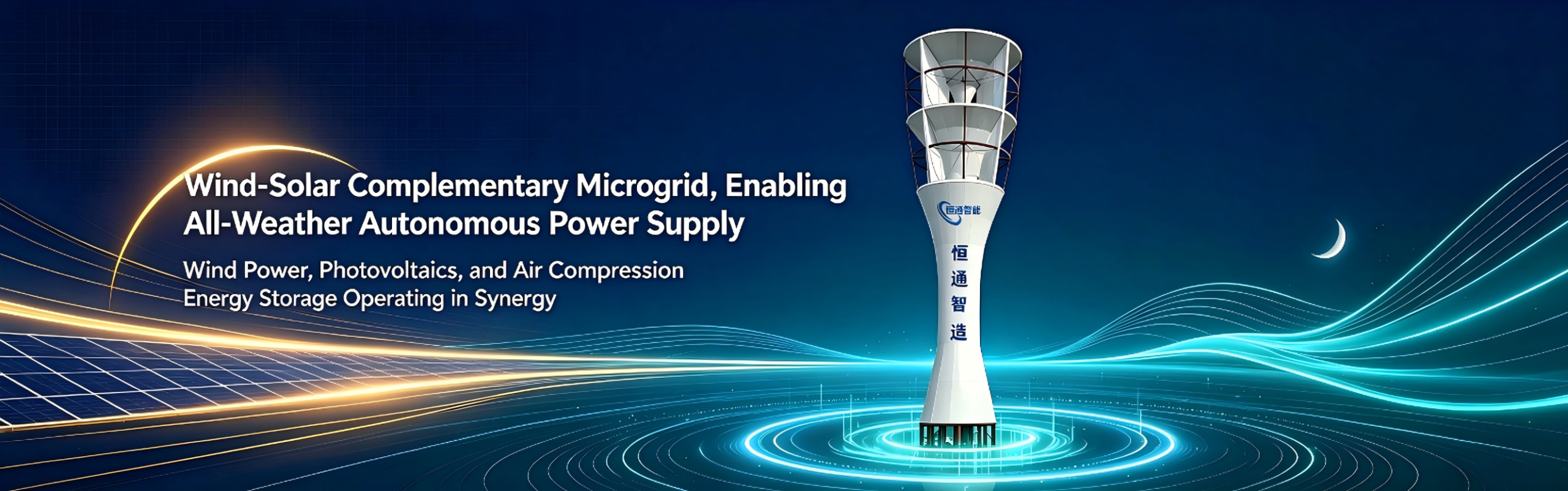
All-weather autonomous power supply solution
Wind and solar power are currently the two most widely used forms of clean energy, but each has significant limitations when used in isolation. Photovoltaic power generation relies on sunlight; its efficiency drops significantly at night, on overcast or rainy days, or during periods of smog, and generation may even cease entirely.
Wind and solar power are currently the two most widely used forms of clean energy, but each has significant limitations when used in isolation. Photovoltaic power generation relies on sunlight; its efficiency drops significantly at night, on overcast or rainy days, or during periods of smog, and generation may even cease entirely.
Wind power generation relies on natural winds; however, wind speeds fluctuate considerably and vary markedly between day and night, resulting in insufficient stability of power supply. Neither a standalone photovoltaic system nor a standalone wind power system can achieve a truly stable, round-the-clock power supply, making it difficult to meet the demands of scenarios requiring uninterrupted electricity.
Based on its proprietary micro-wind energy storage power generation system, Hengtong Intelligent Manufacturing has developed an integrated solution for wind-solar hybrid microgrids. By deeply integrating the Venturi wind concentration system with photovoltaic power generation systems, and combining this with air compression energy storage technology, the solution achieves complementary use of wind and solar energy, with energy storage providing voltage stabilisation and a safety net. This enables the construction of a distributed microgrid that is autonomous, controllable and capable of all-weather operation, thereby completely resolving the industry-wide challenge of unstable power supply from a single source of clean energy.
This hybrid wind-solar system is highly adaptable to different scenarios, with the two energy systems each performing their respective functions whilst complementing one another. During the day, when sunlight is abundant, the photovoltaic modules take precedence in power generation, providing the main source of electricity whilst converting surplus energy into compressed air for storage; during periods of light winds or gusts during the day, the wind power system provides supplementary energy to bridge the gap in power generation caused by fluctuations in sunlight; at night, when there is no sunlight, or during overcast or rainy days with light winds, the system releases the stored compressed air to generate electricity continuously, ensuring an uninterrupted power supply. Compared to a single-energy system, the overall duration of power generation, energy utilisation efficiency and supply stability are all significantly improved.
Compared with traditional battery energy storage, the air compression energy storage system incorporated into the equipment offers greater safety, a longer service life and no risk of battery degradation. It avoids the drawbacks of lithium-ion batteries—such as flammability, explosiveness, ageing and scrapping, and high replacement costs—making it more suitable for long-term, round-the-clock operation outdoors. The entire microgrid system does not rely on the mains grid; it can operate independently off-grid or be connected to the grid for self-generation and self-consumption, offering exceptional adaptability.
It is widely applicable in remote rural areas, outdoor telecommunications base stations, forest fire monitoring stations, livestock and crop farming bases, scenic area lighting schemes, and outdoor work camps. Not only does it significantly reduce reliance on the mains electricity supply and lower electricity costs, but it also completely resolves issues such as power cuts, voltage instability, and the high pollution and costs associated with diesel generators. It is currently one of the most stable, hassle-free and long-lasting solutions for the construction of distributed zero-carbon microgrids.