
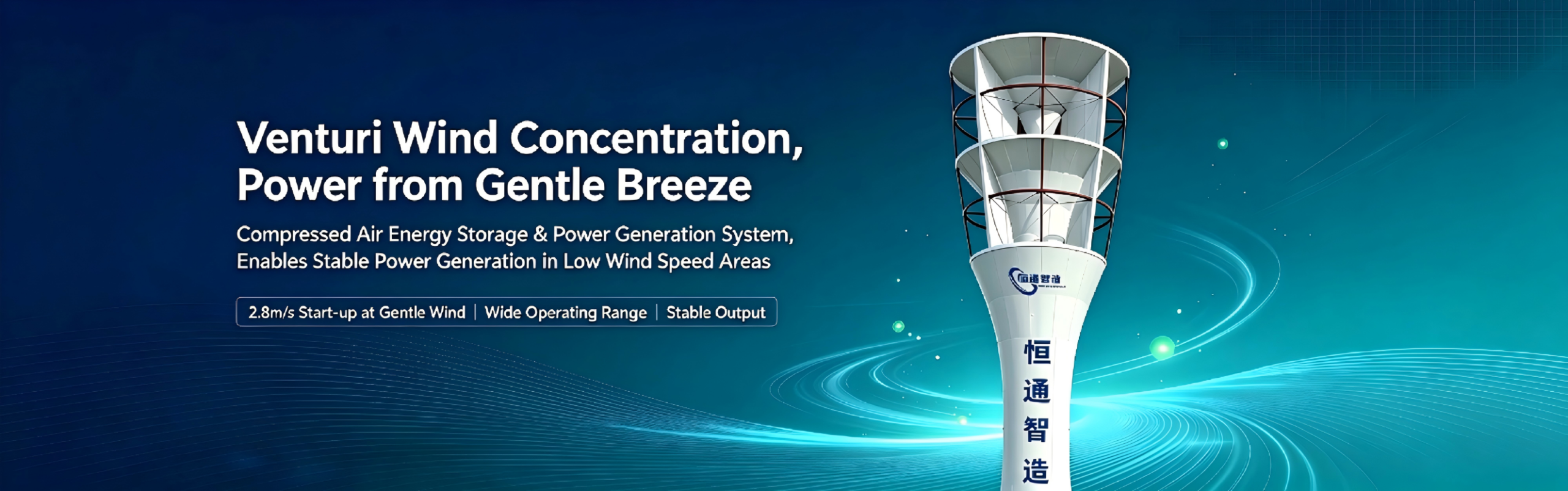
How the Venturi Effect is Revolutionising the Use of Distributed Wind Energy?
The New Challenges for Distributed Wind Power in the Era of Low Wind Speeds
As the ‘dual carbon’ targets continue to be implemented, distributed clean energy is shifting from large-scale centralised power stations to industrial sites, rural areas and buildings. However, traditional wind power has long faced a fundamental contradiction: large horizontal-axis wind turbines rely on stable, high wind speeds, whereas vast swathes of China’s inland regions are characterised by low wind speeds — with low average annual wind speeds, frequent gusts and variable wind directions.
Conventional wind turbines typically require a cut-in wind speed of over 3 m/s to start up, whilst the rated power generation wind speed is around 10 m/s. This means that in most low-wind-speed regions, the amount of time conventional wind turbines can be used for power generation during the year is very limited, resulting in a significant amount of wind energy resources being wasted. At the same time, decentralised power consumption scenarios—such as industrial estates, telecommunications base stations and rural electricity supply—have a pressing need for stable, safe and small-scale clean energy equipment.
Hengtong Intelligent Manufacturing’s air-compression power generation system was developed against this industry backdrop. Rather than following the traditional approach of ‘making larger blades and taller towers’, we started from the fundamental principles of fluid dynamics and innovatively introduced the Venturi airflow concentration effect, thereby redefining the technical approach to low-wind-speed power generation.
The Venturi effect: ‘amplifying’ a gentle breeze into usable kinetic energy
The Venturi effect is a classic and well-established physical principle in fluid mechanics: when a fluid flows through a channel with a gradually narrowing cross-section, the flow velocity increases significantly, whilst the static pressure decreases correspondingly. This effect has been utilised for over a century in aircraft engines, chemical processing pipelines and automotive intake systems.
Hengtong Intelligent Manufacturing has creatively applied this principle to the field of wind power generation. A special wind-concentrating chamber structure has been designed at the top of the equipment; as natural wind enters through the wide air inlet, the cross-section of the passage gradually narrows, causing the wind speed within the chamber to be amplified many times over. The initially weak airflow, which was only 2–3 m/s, is accelerated by the wind-concentrating structure, enabling the wind speed at the drive end to reach a level sufficient to drive the generator set to operate efficiently.
This design delivers two key breakthroughs:
The start-up threshold has been significantly reduced. Thanks to the wind-concentrating effect, the system requires an ambient wind speed of just 2.8 m/s to start up, which is nearly 30 per cent lower than the cut-in speed of conventional wind turbines. On typical days with light winds, whilst conventional wind turbines remain idle, the Hengtong Intelligent Manufacturing System has already begun capturing energy.
The range of wind speeds that can be utilised has been significantly expanded. The system operates stably across wind speeds ranging from 2.8 m/s to 25 m/s, meaning that whether it is a gentle breeze at dawn, an afternoon gust, or a sustained light breeze in spring or autumn, the wind can be effectively harnessed and converted into usable energy. For areas with low wind speeds, this means a significant increase in the number of hours over the year during which electricity can be generated.
Axial-flux motor: the core component for operating in light wind conditions
The wind-concentrating structure addresses the issue of ‘availability of wind’, whilst the performance of the generator itself determines the energy conversion efficiency. The Hengtong Intelligent Manufacturing System is equipped with an axially flux-controlled motor developed in-house; compared with traditional radially flux-controlled motors, axially flux-controlled motors offer higher power density and a wider range of high-efficiency operating speeds.
Even at low rotational speeds, the axial flux motor maintains a high conversion efficiency and does not suffer from the situation where it ‘can rotate but cannot generate electricity’ due to low wind speeds. This complements the Venturi airflow concentrator perfectly: the concentrator increases the airflow velocity, whilst the motor efficiently converts energy across a wide speed range; working in tandem, they convert every bit of kinetic energy from the gentle breeze into electrical energy as much as possible.
Air Compression Energy Storage: The Fundamental Solution to Wind Power’s Reliance on Weather Conditions
The use of wind concentrators has resolved the start-up issue, but conventional wind power still faces another, more intractable problem: intermittency. When the wind is strong, there is a surplus of electricity; when it is light, there is a shortfall. The output voltage fluctuates sharply with wind speed, making it unsuitable for direct connection to precision electrical equipment and rendering it difficult to use as a stable backup power source.
The core innovation of the Hengtong Smart Manufacturing System lies in the integration of an air compression energy storage unit. The entire energy flow forms a complete closed loop:
- Wind energy capture stage: Natural wind is accelerated by a Venturi wind-concentrating structure, driving the wind turbine to rotate;
- Mechanical energy conversion stage: The rotor drives an axial-flux generator, converting rotational kinetic energy into electrical energy;
- Energy storage stage: When wind energy exceeds current electricity demand, the surplus energy drives an air compression unit, compressing air to a high-pressure state for storage;
- Stable energy release stage: When wind speed decreases or electricity demand rises, the energy storage unit releases the compressed air in an orderly manner, enabling the unit to continue generating electricity.
This mechanism has completely transformed the traditional, passive situation in wind power generation where ‘when the wind stops, so does the power’. The system no longer fluctuates dramatically with wind speed; instead, it converts unstable wind energy into a stable, controllable and continuous power supply by ‘smoothing out peaks and troughs’. For precision equipment in industrial estates, the uninterrupted power supply required by telecommunications base stations, and domestic electricity consumption in rural areas, this stability is of greater practical value than peak power output.
Smart Control and Wind-Solar Hybrid Systems: All-Weather Energy Solutions
In addition to the energy storage unit, the Hengtong Intelligent Manufacturing System is also equipped with an intelligent voltage stabilisation control system. The controller monitors various parameters in real time, including wind speed, energy storage pressure and output voltage, and dynamically adjusts the energy discharge rate and power generation output to ensure that the output power remains within a stable range at all times, preventing sudden spikes or drops in voltage.
The system also supports hybrid solar-wind expansion. Users may, depending on site conditions, opt to integrate photovoltaic modules to operate in conjunction with the wind power system: during the day when sunlight is abundant, the photovoltaic system takes priority in supplying power, whilst wind power supplements this during the windy season or at night. The two clean energy systems complement one another, further enhancing energy self-sufficiency and the reliability of the power supply.
For remote sites, outdoor work camps and agricultural and livestock farming bases located far from the main grid, the hybrid wind-solar model can significantly reduce the need for diesel generators, or even replace them entirely, thereby reducing fuel transport costs whilst eliminating noise and emissions pollution caused by diesel generators.